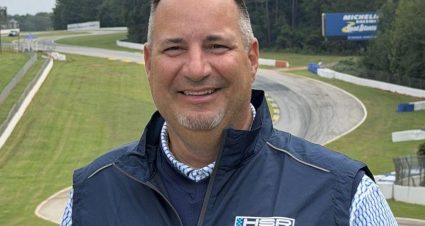
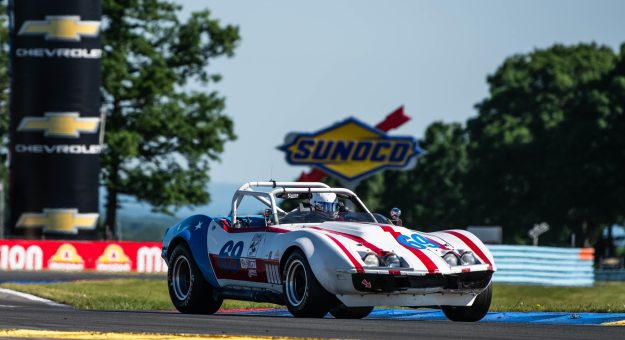
In the 250th celebration year of the United States, it is hard not to look at Chevrolet as one of the pillars of the American automotive industry. Chevrolet is an all-American staple not only on the road but also on the track, and few racing Chevies scream the American dream more than the patriotic 1968 No. 69 Chevrolet Corvette C3 Roadster Cord Kisthardt drives at HSR events.
“We looked for a Corvette from the C2 or C3 era that had actual history for a long time because we wanted something that was documented,” Kisthardt said. “Preferably something that ran IMSA back in the day and whatnot. Really, the late 1960s and early ’70s are my favorite era of motorsport, as I think they are for a lot of people. We raced a contemporary Corvette for the past 10 years, give or take, and then we decided we wanted to go vintage racing. We looked for a while for a Corvette that had that history and landed on this one.”
The specific Corvette that Kisthardt owns carries a long and storied racing pedigree. Competing in the original iteration of IMSA’s Camel GT Championship, the car has experienced its fair share of historic moments, including appearances in races such as the 500-mile race at Pocono, the Mid-Ohio 6 Hours, and the Sahlen’s Six Hours of The Glen.
“It started out as a 1968 Corvette,” Kisthardt said. “From day one, it was a race car. They turned it into a B Production car and ran SCCA until 1972. Then, in ’73, it started running IMSA in Camel GT and whatnot. Then it ran Daytona in ’75 and ’76. In ’77, it became a Trans Am car. It has a Greenwood front end, which we have at home. It crashed at Sebring in ’77.
“In ’75, in preparation for the Bicentennial, they painted it red, white, and blue. Originally, it was red with yellow. It was a Yankee Silicone car. There were two of them.
It was GM’s attempt at silicone brake fluid. Then it got painted red, white, and blue in celebration. Pretty much every Corvette did back in ’75. They all were red, white, and blue. The paint that’s on the car is from ’75.”
Kisthardt not only focuses on keeping the car cosmetically accurate but also on ensuring all components remain period-correct to the era in which it competed in the
Camel GT Championship. “History is really important to us and the actual traceability of what the car did,” Kisthardt said. “That’s why the car is preserved the way that it is. We could put other stuff in the car to make it more modern, but the car is the way that it was raced. It has L88 flares. Actual GM L88 flares. If they wanted to go run SCCA one weekend, they’d cut the flares off because they weren’t allowed, and then they’d put them back on when they wanted to run IMSA.
“So, it looks crude. I mean, that whole car is very crude, but the way it’s done is almost like a time capsule. Some cars get built up, and that’s why the history and honoring that history matters.”
Even with a long history behind it, Kisthardt’s 1968 No. 69 Chevrolet Corvette C3 Roadster continues to have a story to share as the young racer works to keep its
American-born legacy alive.
“The way this car is, it’s neat to look at it and see, ‘ Oh, well, this is the way it was back then,’” Kisthardt said. “I think one of the coolest things was in ’23 when we ran up here, two or three people came up and said, ‘I remember this car from back when we raced against it.’ That’s just cool, to hear those stories, and hopefully getting to share that with people is something that I enjoy.”
Next up on the HSR series competition calendar is the HSR Classic Road Atlanta 10 Hour presented by Mission Foods and the HSR Atlanta Fall Historics, September 17 –20, at Michelin Raceway Road Atlanta.