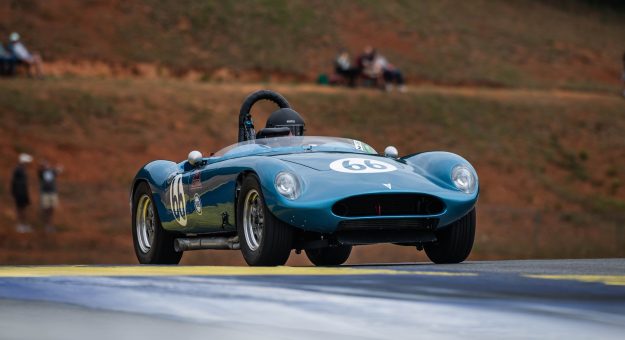
Long before factory-backed sports car programs and advanced prototype engineering, a Minnesota-based trio spent winters in the late 1950s building something far more
improvised. Using a shortened and reinforced 1956 Chevrolet passenger car frame, the group created a lightweight special that became known as the Echidna.
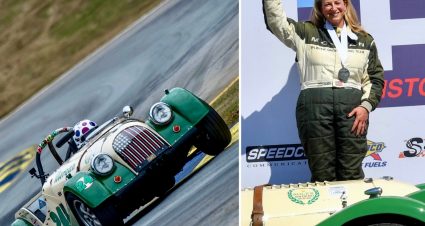
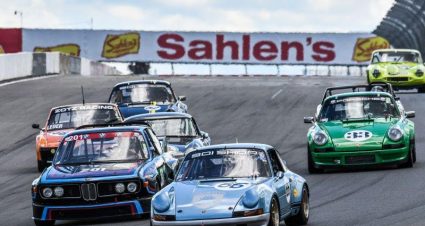
More than six decades later, one of only three Echidnas ever built is still competing in HSR competition with owner-driver Randy Green and team Furia Corse.
Built from a mixture of available Chevrolet components, Corvette drum brakes, a Devin body, and small-block Chevrolet power, the Echidna was simple, raw, and effective. In an era dominated by European manufacturers, cars like the Echidna proved American-built specials could compete with established names on road courses across the country.
“The car was owned by Jerry Hansen, who won 27 SCCA titles,” Green said. “He was probably the winningest SCCA driver in history, and being from Minnesota myself, I
always had an interest in his career. He ice-raced this car up north and also road-raced it before eventually selling it and buying a Scarab when Augie Pabst was winning with those cars.”
After Hansen’s ownership ended, the Echidna spent years sitting behind a shed due to extensive race damage before eventually being rediscovered and restored by Steve Steers, who returned the car to competition in 1999.
“Steve raced it everywhere from Watkins Glen to Sebring to Road America for about 25 years before I bought it,” Green said. “It’s still got the original frame, rear end,
transmission, and engine. And because Chevrolet officially wasn’t supposed to be involved in racing back then, the Rochester fuel-injection systems actually went directly
to Zora Arkus-Duntov himself for tuning.”
Still wearing its original medium-blue livery, the car remains a true throwback to its earliest days, reflecting the simplicity and raw character of late-1950s sports car racing. Built with minimal compromise and without modern driver aids, the ’59 Echidna Special demands the same hands-on approach that defined the era, something Green particularly appreciates despite his experience with more modern machinery.
“The reason I got back into HSR-type racing was just the purity of these old cars,” said Green. “I just want to have fun with the car, and how I do in the race is secondary to me. But just having the car out there, showing people… I mean, can you imagine a whole field full of these kinds of cars back then? I just think it’s cool. But it’s important to me to keep awareness of what I think is really, truly vintage, vintage.”
Being one of only three cars in existence, the ’59 Echidna Special draws attention throughout an HSR weekend, from older spectators who remember the era it represents
to younger audiences discovering something entirely new.
“I was at one of the races, and the most enjoyable thing that happened to me was some little kids came afterwards with gifts,” Green said. “There was like a five-year-old, an eight-year-old, a 10-year-old. They gave me a rock with a star on it – a blue star – so ‘rock star.’ And then they said, ‘Number 66, you rule.’ They wanted to know what kind of car it was. And these were kids that were like six years old to 10 years old, and they had more interest in that car than any other car that was out there. That was like the highlight of my weekend.”
Green believes organizations like HSR are critical to preserving historic race cars by continuing to provide venues for them to compete rather than disappear into private
collections.
“I think HSR is important because it provides the venues and going to provide the opportunity,” Green said. “And if you don’t have those, these cars will just be sitting in
someone’s garage. They should be out on the track. The car runs fine. The car runs great, so it should be out, it should be racing somewhere.”